


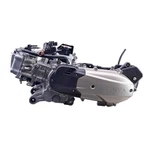
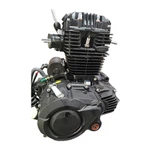
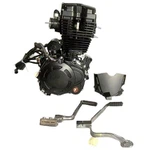
Engine




CHONGQING SHENGWAN MOTORCYCLE CO.,LTD
Stablished in chongqing, China , We focus on the research and development, sales and after-sales service of motorcycles engines and engines' parts .Our company have employs experienced technical and management personnel, Sales and After sales team.With high quality products and perfect after- sale service,it has won trust and support of customers all over the word.
Why Choose Us
Professional team
Professional sales team and engineer team provide professional technical Support,Test video and Sample support .
One-stop Solution
With rich experience and one-to-one service,we can help you choose products and answer technical questions.
Commitment to quality
We're committed to quality and concrete actions. That means we always deliver solutions in a professional and practical way.
World-wide expertise
We know international markets and trends. Our expertise, experience and network cover all corners of the world.
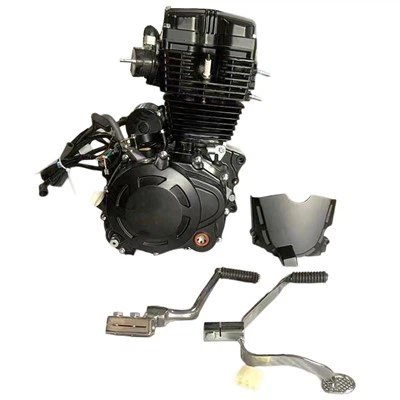
Motorcycle Engine

Check the radiator, coolant, and fan
Liquid-cooled engines have a radiator and coolant that is pumped through the engine to remove heat. There is also a fan that kicks in after a certain temperature to remove excess heat. When all three components work fine, an engine will not overheat. if there is a problem with either of them, engines can overheat.
One way to avoid an overheating scenario is to check the coolant at regular intervals. Check the level, and top it off if necessary.if the problem persists, flush the coolant and refill it, ensuring there are no airblocks. Use a good quality coolant.
Also worth checking are the radiator and fan. Check the radiator for leaks or crushed fins. If you spot any damage, get the radiator fixed by a professional and if the damage is too much, replace it. The same goes for the fan and if the fan refuses to turn on, it could be a problem with the switch of the thermostat.
Change fluids regularly
Engine oil plays a crucial role in keeping engines from overheating to a certain extent, so make sure you change the oil at regular intervals, as per the manual. Use a good quality engine oil and the one recommended by the manufacturer.
Most modern bikes have one oil for the engine, clutch, and gearbox, however, some older motorcycles have separate oil for the engine, clutch, and gearbox, so make sure they are also changed when servicing the motorcycle.
Stop hitting the limiter
A primary way to prevent the engine from overheating is to ride responsibly and stop hitting the rev limiter in each gear or when idling. More revs cause more heat and the engine components have to work extra hard to remove the heat, so do not over-rev the motorcycle. Doing so can not only harm the engine, but also damage the clutch, and other components of the motorcycle.
We’ve more or less shown that it doesn’t matter how you break in an engine, the results will be the same, right Well, not exactly. The CB300F, even when operating at WOT, just isn’t working that hard because it’s in a mild state of tune. Each motor is different, with different cylinder materials and compression ratios and redlines, but the lesson here is that there doesn’t appear to be a night-and-day distinction between break-in methods, so don’t sweat it. Motorcycles are meant to be enjoyed, so just go ride it and enjoy it.
The long and drawn-out recommendations found in all owner’s manuals persist for two reasons.the methodology is a holdover from days of yore, when metallurgy, machining technology, and lubricants weren’t nearly as good as they are today.
Taking it easy with a new bike is just a good idea. After all, it’s not just your engine that needs to break-in. You need to scrub in those new tires, bed in those new brakes, and overall get familiar with how your new bike is balanced, how it turns and handles, shifts and stops. Modern motorcycles are amazingly reliable, but failures still happen, and most major issues are likely to happen within the first few hundred miles. Wouldn’t it be better to have something break or come loose while trundling along at 25 mph instead of 75 There are lots of good reasons to give yourself and your bike a day or two of gentle riding to shake things out.

A seized motorcycle engine is a critical issue
A broken connecting rod, while severe, is a relatively rare malfunction. It usually occurs when the engine is subjected to frequent "over-revving," exceeding the maximum RPM allowed. This can happen due to persistent lubrication problems or a combination of the two factors. Lubrication is vital in reducing friction between engine components and protecting against excessive heat. Without proper lubrication, the engine is at risk of seizing, especially during dreaded "over-revving in downshifting.” This occurs when downshifting too many gears simultaneously, causing the engine RPMs to surge well beyond the maximum limit allowed due to the inertia of the moving mechanical parts, posing severe risks to the engine's integrity.
This also happens when motorcycle maintenance intervals are not respected, or the vertical clearance of the connecting rod is not checked (moving it upwards should not produce any noise or tapping; if it does, the connecting rod head itself may fail). Motorcycle maintenance intervals are determined based on either engine running time or mileage, depending on which occurs first. Due to the cost of servicing, motorcycle manufacturers are trying to extend maintenance intervals as much as possible. Until a few years ago, few manufacturers scheduled intervals beyond 5,000 km (including Japanese brands).it is not uncommon to have the motorcycle serviced every 8,000 to 10,000 km, and this also applies to scooters. The situation is slightly different for off-road motorcycles, which require more frequent maintenance intervals. Knowing how often the "pit stop" at the repair shop is scheduled also provides a more accurate idea of the maintenance costs.
When a motorcycle engine seizes, it is common for the connecting rod pieces to cause severe damage to the cylinder, piston, and crankshaft, making it impossible to use the motorcycle and resulting in very expensive repairs.
ATV Engines Work
Here’s how a four-stroke engine works. The starter engages the engine and the piston moves down into the cylinder. At the same time, the intake valve opens, pulling air and fuel into the cylinder.
When the piston reaches the bottom, the intake valve closes and the piston starts moving back up to compress the fuel/air mixture. That is when the spark happens, creating a small explosion inside the cylinder. That burns off the fuel and air mixture and forces the piston back down again. It moves back up one more time, as the exhaust valve opens to let burnt gasses out through the exhaust.
In a two-stroke engine, the power cycle is completed in two rotations. The piston starts at the bottom center of the cylinder. The rotating crankshaft pushes the air and fuel mixture into the cylinder, and that mix is compressed as the piston moves upward. This is the first half of the stroke.
When the piston gets to the top center position, the spark plug ignites the fuel and air mix, which pushes the piston back down. Exhaust gases are expelled as more fuel and air is brought in.
Fuel mix travels through the crankcase throughout this process, which necessitates oil to lubricate the case. Two-stroke engines often require pre-mixed fuel and oil. If you want to avoid this, look for an engine with an oil injection feature, which does this for you.
When the engine is powered through these piston strokes, whether two or four, it turns the ATV’s wheels.

Different Types of ATV Engines
All-terrain vehicles (ATVs) can be equipped with one of several engine designs. Atv engines are available in two - and four-stroke designs, as well as air - and liquid-cooled versions. There are also single-cylinder and multi-cylinder ATV engines used in various designs, which can be carburised or fuel injected, depending on the model. Other variables found in ATV engines include displacement, which is 50 to 800 cubic centimeters (CC) for common engines. While the most common type of fuel used in the engine is gasoline, an increasing number of ATVs are now designed to be electric motor or battery powered, and some are even powered by diesel engines.
Many buyers of the new ATV do not give a great idea of the ATV engine variety to choose from. This may be a serious oversight, however, as ATV engines tend to require the type of ride that will best suit ATV. Early versions of ATV engines were often dual-cycle versions, which required oil to be mixed with fuel. This can be done in one of two ways: by mixing or injecting the dual-cycle oil with the gasoline in the tank. Filling is usually the preferred method, allowing the driver to fill the tank directly from any fuel pump as long as sufficient fuel is injected into the tank.
Atv engines usually require the type of ride that will be best suited to ATV.
The four-cycle ATV engine allows the rider to use gasoline directly from the pump without the need to refuel. This is similar to how an ordinary car engine works. Other advantages of this type of engine are reduced emissions due to pollution, less exhaust gas for the rider to breathe and a wider power band. Unlike two-stroke engines, four-stroke engines provide the driver with a greater power range, which can be found at all points in time by the engine's revolutions per minute (RPM). Two-stroke engines typically have a power band close to the upper mid-speed range, where the engine produces peak power.
ATV engines can be powered by gasoline or even diesel fuel in some cases.
It is common for a particular ATV engine to be offered only in a particular ATV, with no option for the buyer to choose a particular engine in a new ATV. Engines are usually targeted at certain machines and larger engines are placed in the better choice of machines. Four-wheel drive models typically have the largest engines, as the use of these machines is often associated with plowing, pulling, and off-road hill climbing. For example, the LINHAI LH1100U-D adopts the Japanese Kubota engine, and its powerful power makes it widely used in farms and pastures.
Our Factory
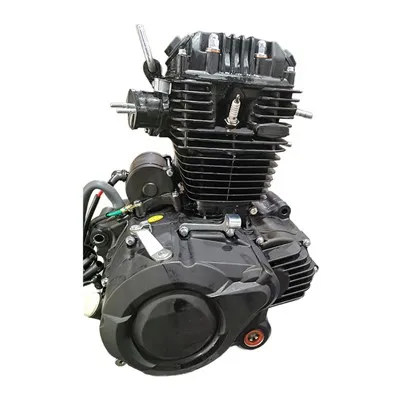
At present, our products are 50CC---350CC air-cooled and water-cooled series two-wheeled vehicles, tricycles and some special engines for off-road vehicles, which are favored by the market with best sales nationwide and comply international standards and exported to Southeast Asia, Europe, the United States and foreign markets.
